The Future of Your ERP Part 1: What’s next for your traditional ERP infrastructure?
If you’re running your ERP on-premises or in a datacentre, at some point you’ll need to decide what comes next.
5 minutes

Author: Liam Freeman, Infrastructure Director, Klipboard Managed Services (formerly Excenta).

It might be time to replace your hardware; you might be considering the risks around securing that infrastructure or you might be thinking about changing software too. It’s something businesses might consider every five or ten years, so it’s not a decision to be taken lightly.
Whether you’re moving from on-premise to the cloud, or from one platform to another, there are a few fundamentals that always matter: performance, security, resilience and management.
Performance and Sizing
How much licensing will I need and how is the database built, is it Microsoft SQL, Oracle or something else? How much data I am working with, and how can I maximise performance in this key area? These are all key questions you need to consider.
Key Takeaway: Can I get my database(s) fully into memory?
Before you even think about moving anything, benchmark where your performance is today. It could be infrastructure monitoring, database monitoring or even better, real application metrics (how long does it take me to make a sale?). Understanding where you are today allows you to plan to maintain performance at a minimum but ideally improve on it.
Key Takeaway: How can we prove what ‘Good’ looks like?
Connectivity plays a part. Whether you’re staying local or moving to the cloud, your network architecture must support the way people connect to your ERP. A slow connection makes the best infrastructure unworkable.
Security & Access
Security of the perimeter is no longer enough. People work from home, they travel, they connect from customer sites and sometimes they use their own devices. That means secure access has to be built into the environment, not added afterwards.
Key Takeaway: Can I drive security without introducing friction by using controls such as MFA (multi-factor authentication), geo-blocking, device compliance?
To support that, we need to think about how we control identities, enforce MFA and conditional-based access. Security tools like antivirus software need to do their job but also can’t get in the way of performance. That’s a skillset all of its own to manage. Lastly, if your business has to meet frameworks like Cyber Essentials, GDPR or PCI DSS (Payment Card Industry Data Security Standard), then compliance has to be baked right into the solution.
Key Takeaway: What kind of options for resilience and continuity does our chosen platform provide? Is it flexible or a one-size-fits-all approach?
Define your recovery point and recovery time objectives before you start building anything. That sets the tone for the SLAs of the environment you’re building, i.e. whether you need 99.9% or 99.99% uptime. The right setup is one that balances the real operational risk with the cost of building and managing the infrastructure.
Management & Operations
Once it’s live, who’s responsible for keeping it running? Monitoring shouldn’t just be about whether a disk is full – it should look deeper and understand more of processes in your key ERP. A service might be running, but what if transactions aren’t flowing between your Sales and Financial products – can your monitoring investigate at that level?
Key Takeaway: How can we know first when the ERP itself has gone wrong, rather than just waiting for a user to call?
User management can be an area to consider. If your ERP isn’t integrated with your Active Directory or Microsoft 365, then that means extra work to manage new hires, leavers or even just make changes to existing users. Then there’s the software around the ERP – reporting tools, bolt-on tools, integrations – all of it needs somewhere to live, and someone to maintain it.
Key Takeaway: How much friction can I reduce with this system from a user logon perspective? How can I make it easy for users to consume multiple tools and software? How do those tools and software map to one another?
Lastly, you can’t forget licensing after all of this, and you might need to think about things like operating systems, database software like SQL Server or Oracle - or remote access licensing like Remote Desktop if your system is a thick client application. If you’re considering web browser-based software, you need to think about the types of devices you’ll access it from and what controls and tools you might need for those.
Summary
Moving or modernising an ERP infrastructure platform isn’t just a typical IT project. It’s a business decision that can have a long-term positive or harmful impact. Achieving the right outcome depends on understanding what you have today, how your business actually works and where the organisation might be in the mid to long-term.
The goal must be to deliver a solution to your users that supports the way your business operates and wraps not just modern technology but also mature service management around a flexible, agile platform.
For part 2, Where your ERP should live next’ go to Deciding Where Your ERP Should Live Next
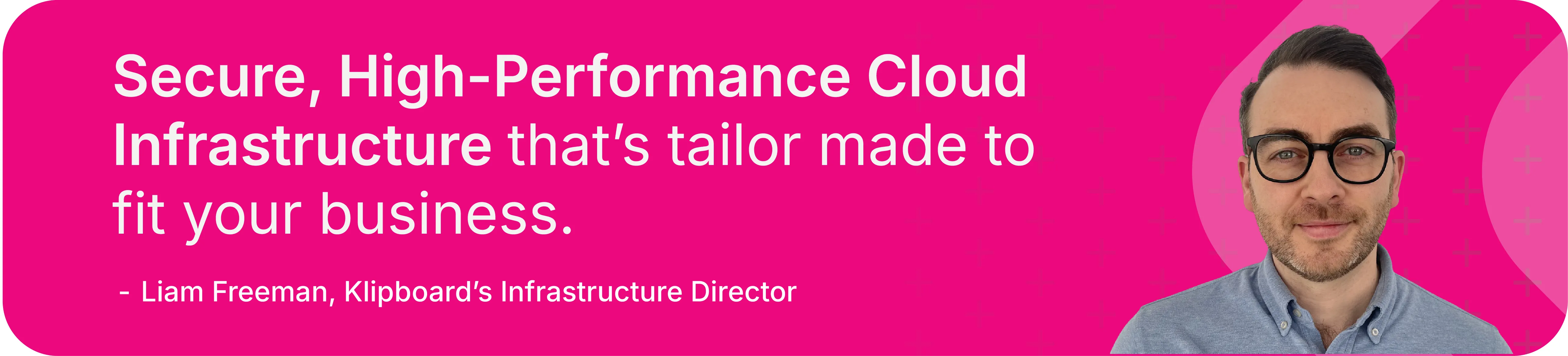
About the author: Liam Freeman is the Infrastructure Director at Klipboard. Klipboard Managed Services, formerly known as Excenta, helps organisations to migrate to, optimise and manage Microsoft Azure and Microsoft 365 environments - on your own terms. Whether you want full end-to-end management or a co-managed model alongside your IT team, our Microsoft-accredited team deliver a secure, high-performance cloud infrastructure that’s tailor-made to fit your business.
Klipboard Managed Services also specialises in managing the cloud environments for companies in the merchant sector, in particular, users of Epicor – BisTrack and Intact IQ application software. Klipboard Managed Services is engaged with more than 50% of Epicor’s UK BisTrack user base, and a growing number of North American BisTrack users. We have extensive experience in providing and managing the Microsoft Azure cloud environments for firms in the merchant sector.
Find out more here: Klipboard Managed Services
Contributors