Card Payment Surcharges Are Ending in Australia – What This Means for Your Business
From 1 October 2026, businesses will no longer be able to surcharge customers for paying by eftpos, Visa or Mastercard.
5 minutes


The Reserve Bank of Australia has announced major changes to card payment rules that will affect how Australian businesses accept payments.
If your business currently applies a card surcharge, it’s natural to ask how your business can deal with squeezed margins. The good news is this change doesn’t happen in isolation; the RBA has also announced measures designed to lower card fees.
What businesses will NOT be allowed to do after 1 October 2026
- Add a checkout surcharge for Visa, Mastercard or eftpos payments.
- Apply different surcharges by card type (credit vs debit).
- Apply different surcharges for foreign‑issued vs Australian‑issued Visa/Mastercard cards.
- Add “cost recovery” fees that are functionally card surcharges.
Why the rules are changing
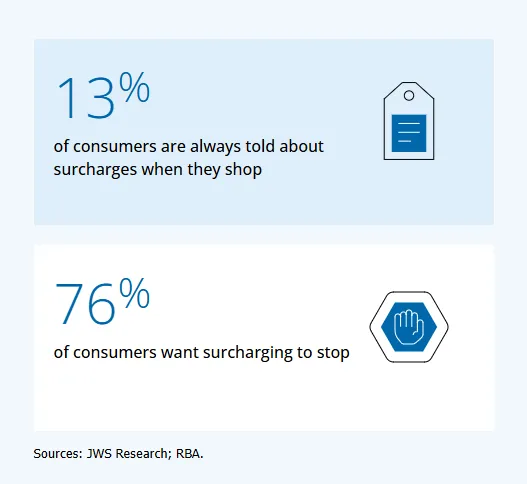
Surcharging was originally introduced to help businesses pass on card costs and encourage lower‑cost payment methods. But the RBA report states that lack of transparency and fee complexity has confused consumers and businesses, and left small businesses paying higher card fees than larger companies. According to the RBA report:
Surcharging is no longer achieving its intended purpose. Previously, surcharging encouraged consumers to use cheaper payment methods. However, it has become harder for consumers to avoid surcharges. Consumers and businesses find surcharging rules complex and confusing, and surcharges are often not well disclosed.
Lower card costs are coming
The RBA’s solution is not just to remove surcharging, but to attack the cost underneath it. Alongside the surcharge changes, the RBA is:
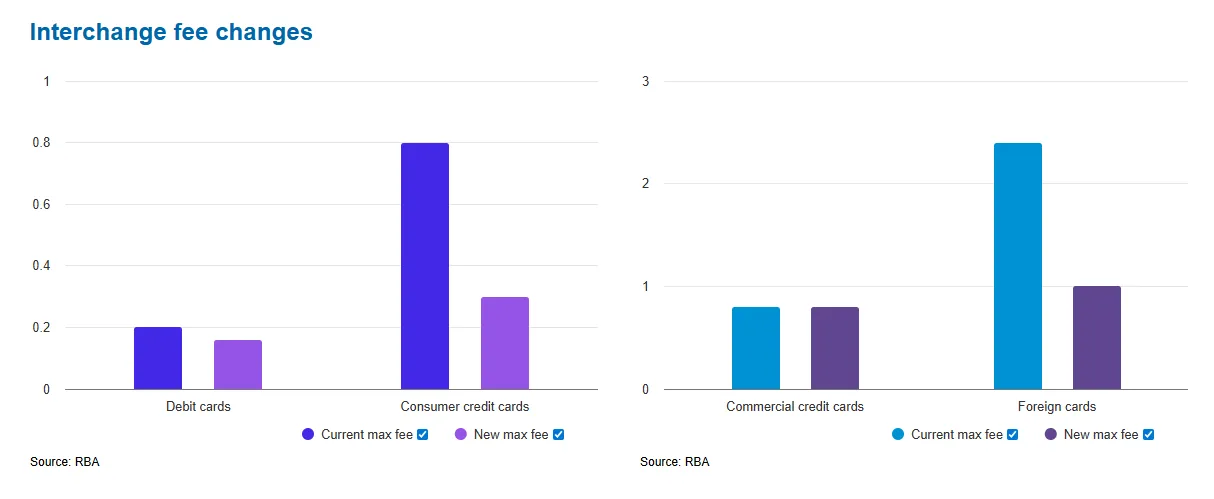
- Lowering interchange fees, which are a major component of card costs.
- Forcing greater fee transparency from payment providers.
- Increasing pressure on acquirers to pass savings through to merchants.
The RBA expects small and medium businesses are expected to benefit the most from these reductions. They say that, for many businesses, the reduction in processing costs will offset much of the surcharge they currently rely on.
Consumer credit cards and foreign cards will see the largest interchange reductions, as shown below:
What should businesses do now?
If your business surcharges or not, you need to start planning for these changes:
Understand your real payment costs
To capitalise on lower interchange fees, your payment provider needs to pass on the reduction. You need to work out how much you pay across different card types, and what mix of card types your customers pay with to determine what your total card fees should be after 1st October 2026. From there you can start to understand how your margins will be affected when you lose the ability to surcharge. If you’re not with a payment provider who's giving you transparency on card mix (eftpos, credit, debit, consumer, commercial) and card fees, and you’re already a Klipboard customer, consider switching to Klipboard Money.
Focus on conversion rates
Consumers have spoken – they don’t want to buy from companies with confusing and opaque fees. They expect the price they see upfront to be the price they see when it comes to payment. The payment experience is increasingly important, and reducing payment friction is key here.
Integrate payments into your business management software
The way payments integrate with your business management software, or ERP, often matters more than a few basis points on card fees. Read our ‘hidden costs of payments' blog post to learn more.
What isn’t covered in the report
In the Introduction to the Conclusions Paper, the RBA explains that this review was not intended to be a full, system‑wide payments overhaul. The below payment types were not included, but the RBA has indicated they will be tackled as part of a larger retail payments review:
- American Express / three‑party schemes.
- Buy Now, Pay Later (BNPL).
- Digital wallets (Apple Pay, Google Pay) as separate pricing layers.
- Payment gateways and facilitators.
- Account‑to‑account payments (e.g. NPP / PayID).
- Emerging payment models and platforms.
Follow Klipboard on LinkedIn to keep up to date on future regulatory changes.
Contributors

Share
Related resources


Running a plant, tool or equipment hire business is about far more than assets leaving the depot on time. It’s about keeping people, paperwork and payments moving smoothly, often under pressure. From early morning collections to last minute extensions and end of day reconciliation, the working day is shaped by how easily money flows through the business.