Your Server vs Cloud – Considerations, Trade-Offs and Costs – Part 1 – Hardware and Lifecycle Costs
If your ERP system runs on-premises or within a hosted data centre using your own infrastructure, you’re likely relying on one or more physical servers.
5 minutes

For many organisations, this setup has worked reliably for years. However, as hardware ages and lifecycle milestones approach, businesses often begin reviewing whether traditional server environments remain the most practical long-term option.
In this five-part series, we’ll explore some of the key differences between on-premises infrastructure and cloud-based platforms, focusing on:
- Hardware and lifecycle costs.
- Software and licensing.
- Management overheads.
- Resilience and continuity.
- Commercial visibility.
To keep the discussion consistent, we’ll reference Microsoft Azure as the cloud platform, as it is commonly used for Windows-based ERP environments
Hardware and Lifecycle Costs
Topic On Premises Cloud (Microsoft Azure) Initial agreement Finance or purchase upfront servers, storage, networking and hardware typically on a 5-year term. You consume compute (cloud servers) storage and backup capacity as a service. There’s no hardware refresh cycle; Microsoft themselves manage this. Business growth When we make this purchase, we might be thinking about what we need not just now but also in the future – the next 1-3 years perhaps. We may therefore purchase at that capacity rather than where we are today. You’re only paying for exactly what you need at the time. There’s no need to purchase capacity (servers or storage) for the future, the capacity exists already – you can just expand when you need it. Supporting equipment We might also be thinking around supporting equipment too, e.g. UPS, Racks, physical security – a commonly forgotten element when we consider the true cost of on-premises. Whether you’re paying a fixed cost or a monthly fee to a co-location provider, you’ll need this additional requirement. You can “right-size” (scale up or down) at any time. You can purchase your services in different commercial models, such as Pay-As-You-Go (PAYG), not a long-term commitment, but higher running costs or Reserved Instances/Savings Plans, which have longer term commitments at a lower running cost. Total cost Most of these purchases also include some form of annual outlay as well in terms of incremental maintenance, security subscriptions or vendor warranty renewals, it isn’t typically a flat one-off upfront cost. No power, cooling, rack, data centre or physical security costs explicitly detailed, these are baked into the prices for the cloud resources you’re buying. Performance When performance degrades, business requirements change or we outgrow capacity – or operating systems and hardware become unsupported, we need to expand or replace, and this typically means a capital outlay again. Microsoft bring newer, faster hardware to the cloud every 18 months (thereabouts). In most cases, you can switch your environment to run on the newer hardware in a matter of minutes, potentially resulting in a speed improvement at limited or no extra cost.
In Summary
With traditional server environments, organisations typically make an upfront investment in hardware, followed by ongoing maintenance, upgrades, and eventual replacement.
Cloud platforms shift this model. Instead of purchasing physical infrastructure, businesses consume computing resources as a service.
In practical terms:
- On-premises environments often involve a larger initial expenditure.
- Cloud services convert this into predictable operating costs.
- Flexibility increases, particularly during periods of change.
Over several years, total costs may not differ as dramatically as expected. The key distinction is often how costs behave, rather than their absolute value.
In the next instalment, we’ll look at software and licensing considerations.
If you’d like to discuss your current setup in the meantime, feel free to get in touch.
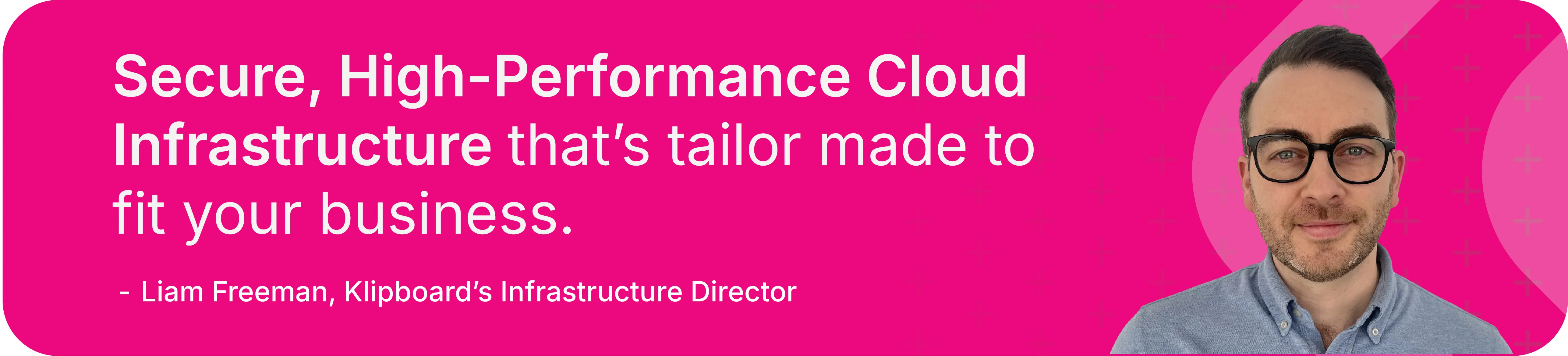
About the author: Liam Freeman is the Infrastructure Director at Klipboard. Klipboard Managed Services, formerly known as Excenta, helps organisations to migrate to, optimise, and manage Microsoft Azure and Microsoft 365 environments - on your own terms. Whether you want full end-to-end management or a co-managed model alongside your IT team, our Microsoft-accredited team delivers a secure, high-performance cloud infrastructure that’s tailor-made to fit your business.
Klipboard Managed Services also specialises in managing the cloud environments for companies in the merchant sector, in particular, users of Epicor – BisTrack and Intact IQ application software. Klipboard Managed Services is engaged with more than 50% of Epicor’s UK BisTrack user base, and a growing number of North American BisTrack users. We have extensive experience in providing and managing the Microsoft Azure cloud environments for firms in the merchant sector.
Find out more here: Klipboard Managed Services
Contributors

Share
Related resources
In this final instalment of our comparison of infrastructure considerations, we turn to one of the most significant factors for many organisations: a clear view of costs and commercial clarity.