A Missed Call is More Than a Missed Call: Why Connected AI is Changing Workshop Customer Service
AI can already answer the phone. But when it connects directly with the systems that run your workshop, it can do much more than simply take a message.
5 minutes

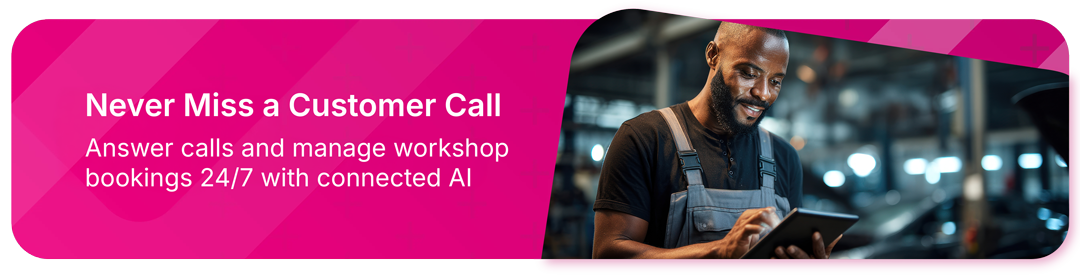
For a busy garage or workshop, the phone ringing isn't unusual.
It might be a customer wanting to make a booking. Someone checking whether their vehicle is ready. A driver who needs to change an appointment. Or a potential customer asking whether you can carry out a particular job.
The challenge is that the phone doesn't only ring when someone is available to answer – it rings when the front desk is dealing with another customer. When the workshop is particularly busy. During lunch. Five minutes before closing. Or when everyone has gone home.
And that's what turns a missed call into a commercial problem, because behind that unanswered phone could be a customer who wants to spend money with your business.
Customers won’t wait for you to call back
Some customers will leave a message or try again. But others won't.
If someone is looking to book an MOT, service or repair, it's never been easier to try another garage. The business that makes it easiest to get an answer and arrange the work can have an immediate advantage.
This makes availability increasingly important.
For many workshops, front-of-house teams already balance customers, bookings, administration and everything else involved in keeping the day moving, so simply putting another person on the phone isn't practical.
There is a better way of dealing with the work behind those calls.
Be available to customers, even when you’re not
The rapid development of conversational AI has created a new option.
An AI receptionist can be available when employees aren't. It can answer common questions, provide basic information and make sure a customer isn't simply greeted by an unanswered phone.
This is useful, but answering the phone is only one part of most customer conversations.
- If somebody wants to make a booking, the useful information is in the booking system.
- If they want to change an appointment, you need to know what they've already booked.
- If their question relates to their vehicle, previous work or a service requirement, the answer may depend on information held elsewhere in the business.
This is where the difference between standalone AI and connected AI starts to matter.
The real opportunity is connecting the conversation to the business
Imagine a customer calls a workshop outside normal opening hours.
A standalone AI receptionist might be able to explain when the garage opens, take the customer's details or capture a message for someone to deal with the following morning.
Connected AI can go further.
When the AI is connected directly to the workshop's operational systems, it can use relevant customer, vehicle and booking information to understand more of the context surrounding the call.
Instead of simply saying “someone will call you back”, it can increasingly help the customer complete what they called to do.
That could mean making, changing or cancelling a booking. It could mean answering a service or parts enquiry. It could mean providing relevant information from the business system or recognising when the conversation needs to be passed to a person.
The objective changes from simply answering the call to understanding why the customer is calling and helping get the job done.
This is a much more significant use of AI.
Make 24/7 availability more meaningful
There is understandably a lot of focus on AI being available 24/7, but a workshop doesn't gain much from having an AI system available at midnight if all it can do is tell someone to call again in the morning.
The value comes from combining that availability with the ability to do something useful. For example, if a customer can call outside opening hours, have a natural conversation and complete a supported task, the workshop has extended the time during which a customer can potentially do business with it.
The same applies during the working day. AI can handle routine interactions when employees are already occupied, giving customers another route to an answer while allowing the team to concentrate on the work that needs their attention.
Connected AI changes the economics of customer service
This is where the conversation about AI receptionists becomes much more interesting for automotive businesses.
The business case is beyond simply reducing the cost of answering the telephone, it’s about capturing more opportunities.
- Every routine enquiry that can be dealt with automatically is time returned to the team.
- Every booking that can be completed when the front desk is busy is an opportunity that doesn't have to wait.
- Every customer who can get an answer outside opening hours has another reason not to go elsewhere.
And as the business grows, connected AI creates the opportunity to handle more customer interactions without automatically requiring the same increase in front-of-house resource. The technology becomes part of the day-to-day.
The best AI shouldn't create more work
Introducing AI shouldn't mean giving workshop teams another disconnected system to manage. If an AI receptionist captures information that then needs to be manually entered into the garage management system, part of the benefit has already disappeared.
The more AI can work with the systems, information and workflows already used by the business, the more useful it becomes.
This is the direction we're taking with Klipboard AI.
The Klipboard AI Service Assistant is designed to connect conversational AI directly with workshop systems, giving it access to the operational context it needs to support customer enquiries and everyday tasks. The initial automotive implementation is designed around garages and workshops, with the underlying capability intended to extend across Klipboard products over time.
It reflects a much broader change in how we see AI developing across business software. AI should increasingly become part of how work gets done.
From answering calls to taking action
The first generation of business AI demonstrated how naturally people can interact with technology.
The next stage is about connecting that intelligence to the systems and workflows where work actually happens.
For workshops, the next generation of AI receptionists will go beyond answering the phone. They'll understand why the customer is calling, have access to the right business context and increasingly help complete the task.
Ultimately, workshops don't need AI that simply answers more calls. They need those calls to turn into better customer service, less pressure on their teams and more opportunities to do business.
Contributors

Share
Related resources

With nearly four decades of industry experience, Nigel Clemett has witnessed first-hand how data and technology have reshaped business operations. Nigel shares insights into how connected systems and accurate information are helping organisations transition from manual workflows to fully digitised, data-driven processes.