Understanding MCP: Connecting AI to Business Software
What is Model Context Protocol (MCP)? Learn how it connects AI assistants with business software, supports workflows and maintains appropriate controls.


What is Model Context Protocol, and why does it matter?
AI is changing how businesses interact with software, access information and complete everyday tasks.
But for AI to be useful in day-to-day operations, it needs access to the right information and, where appropriate, the ability to work with established business processes.
That's where Model Context Protocol (MCP) comes in.
MCP is an open standard that provides a common way for compatible AI applications to connect with external tools and information sources.
It helps AI assistants discover and request available functionality, creating opportunities for more connected experiences across business applications.
Why does MCP matter for businesses?
Most organisations rely on several systems to manage their operations.
Customer information might sit in a CRM system. Stock and orders may be managed through ERP software. Workshop activity, equipment hire and financial processes may involve other specialist applications.
The challenge isn't simply finding information. It's being able to use that information efficiently and move work forward.
MCP can help by providing a standardised way for compatible AI applications to interact with approved tools and information sources.
This creates opportunities to reduce repeated searches, move between fewer applications and make better use of the functionality already available within business software.
From information to action
One of the opportunities presented by MCP is helping AI applications work with the tools needed to support everyday tasks.
Ask a question
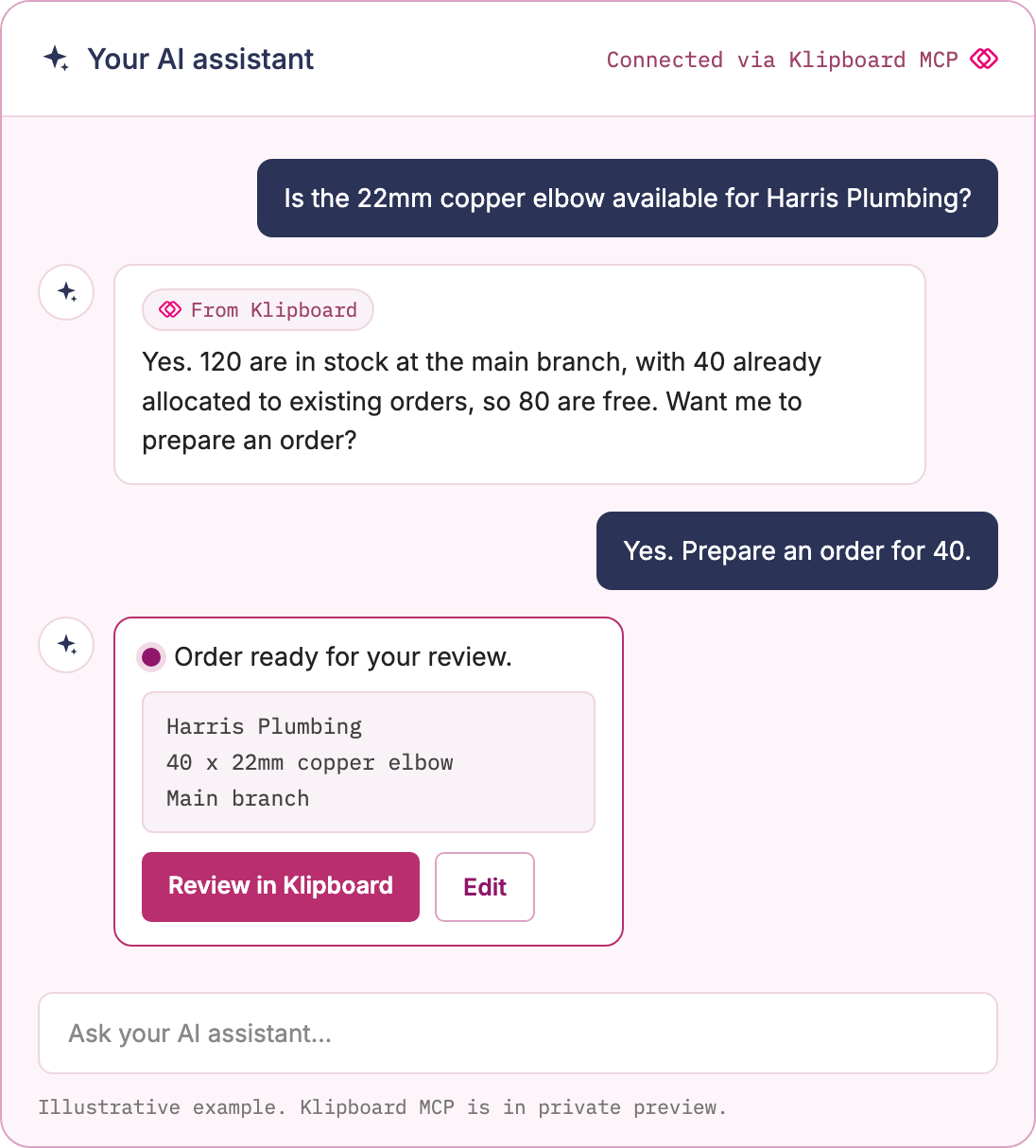
For example, a user might ask an AI assistant whether a particular product is available.
Retrieve approved information
With an appropriate connection, the assistant could retrieve approved availability information from a business system and provide an answer.
Take a supported next step
If additional functionality is available and authorised, the user could then ask the assistant to take a supported next step, such as preparing an order for review.
The software stays in control
MCP provides a way to connect an assistant with available tools. It doesn't create those business capabilities or automatically give an assistant permission to use them. The connected software remains responsible for the functionality it makes available and the rules governing its use.

Why business context matters
Getting the right answer often requires more than retrieving a piece of information.
Rental
Consider an equipment rental business. A particular asset might appear available, but existing commitments or operational requirements could affect whether it can be hired for a specific period.
Distribution
In distribution, stock availability may need to be considered alongside customer requirements or existing orders.
Automotive
In automotive, vehicle information and product suitability can influence which parts or services are appropriate.
Connected AI experiences become more useful when they can work with this operational context rather than treating every request as a standalone question.
This is why the specialist functionality and business knowledge already held within industry-specific software remain so important.
How is Klipboard using MCP?
Klipboard is introducing an MCP service in private preview as part of the wider Klipboard AI Platform.

MCP support does not automatically mean every external AI assistant or Klipboard product capability is available through the service.
What does MCP mean for the future of business software?
As AI becomes more closely connected with everyday business operations, interoperability will play an increasingly important role.
Open standards such as MCP can help create more consistent connections between AI applications and the software businesses already use.
For organisations, the opportunity is to make better use of existing information, functionality and operational knowledge, while giving people new ways to progress everyday tasks.
At Klipboard, this is part of a wider strategy to develop intelligent, connected and industry-specific business software that helps customers move from information to action.

Explore connected AI at Klipboard
Discover how Klipboard is combining embedded AI, industry-specific software and new connectivity capabilities to support more effective everyday operations.